Aortic Dissection Pathways & SOPs – Why Do They Matter?
Mr Marcus Brooks, Consultant Vascular and Endovascular Surgeon, explains how clinical pathways and Standard Operating Procedures (SOPs) can reduce delays, improve patient safety and help people experiencing an acute Aortic Dissection reach the specialist care they need.
An acute Aortic Dissection is a life-threatening emergency in which rapid diagnosis, effective communication and access to specialist treatment can make a critical difference.
But delivering that care is rarely straightforward. From the emergency department to specialist aortic surgeons, critical care teams and ambulance services, many healthcare professionals may need to work together, often across different hospitals and under considerable time pressure.
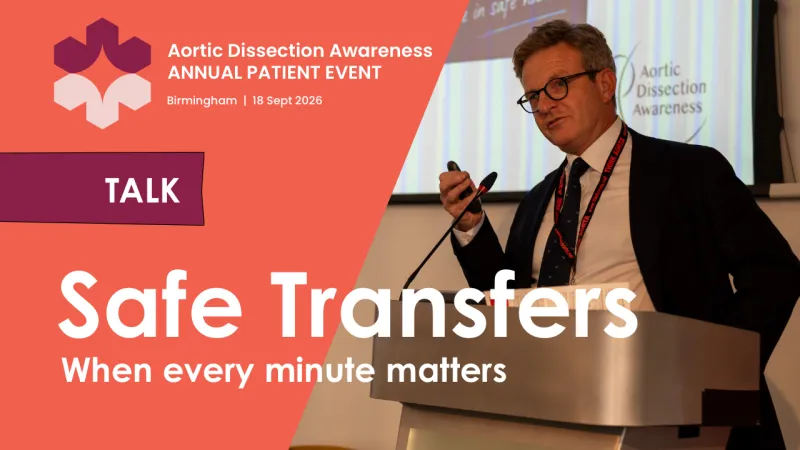
In this presentation from our 2026 Annual Patient Event in Birmingham, Mr Marcus Brooks, Consultant Vascular and Endovascular Surgeon, incoming President of the Vascular Society and medical adviser to Aortic Dissection Awareness UK & Ireland, explores how standardised clinical pathways can help teams manage this complexity, reduce avoidable delays and improve patient safety.
He also discusses the development of the South West's Aortic Dissection pathway, the first of its kind to launch in the UK, and the importance of learning from clinical experience to improve services.
In this talk
- Why Aortic Dissection can be difficult to recognise and diagnose.
- How clinical pathways and Standard Operating Procedures (SOPs) help healthcare teams make decisions.
- The importance of rapid communication between hospitals and specialist aortic centres.
- Why safe, timely transfers are a critical part of emergency care.
- How checklists can reduce errors and prevent avoidable delays.
- The lessons Aortic Dissection services can learn from heart attack, stroke and major trauma pathways.
- Why specialist multidisciplinary aortic teams are essential.
- How patient experiences, clinical audits and better data collection can drive improvements in care.
Why standardised pathways matter
Marcus begins by drawing parallels with aviation, where checklists and standardised procedures have become essential tools for improving safety.
Healthcare has adopted similar approaches, including the World Health Organization's surgical safety checklist, which helps clinical teams avoid preventable errors.
For Aortic Dissection, however, the challenge extends well beyond a simple checklist.
A patient may initially present with symptoms that resemble a heart attack or another more common condition. Once Aortic Dissection is suspected or diagnosed, clinicians must determine the type and severity of the condition, decide what treatment is needed and coordinate care between several specialist teams.
A Standard Operating Procedure (SOP) provides a structured, evidence-informed approach to these decisions, helping clinicians understand what needs to happen, who needs to be involved and how the different stages of care fit together.
Marcus explains how the South West's Aortic Dissection pathway was developed to support this process and help standardise care across the region.
The importance of safe, timely transfers
For many patients, the hospital where they first receive their diagnosis will not be the hospital where they receive specialist treatment.
This makes inter-hospital transfer a vital part of the emergency pathway.
Marcus describes how delays can arise from seemingly small issues, such as incomplete paperwork, difficulties arranging an ambulance or uncertainty about which clinical team should take responsibility.
He explains how standardised procedures can help teams prepare patients for transfer, coordinate communication and anticipate potential complications during the journey.
The ultimate objective is to ensure that patients reach the right specialist aortic team, with the appropriate expertise and facilities, as quickly and safely as possible.
Learning from experience to improve care
While clinical pathways provide an important framework, Marcus emphasises that they must continue to evolve.
He highlights the need for better national data collection covering the entire patient journey, from the first emergency presentation through diagnosis, referral, transfer and treatment.
Existing surgical registries provide valuable information about patients who undergo procedures, but they do not necessarily capture those who never reach a specialist centre, experience complications during transfer or are considered unsuitable for intervention.
Understanding these experiences is essential if healthcare services are to identify problems, evaluate improvements and reduce avoidable harm.
Marcus also recognises the important contribution of patients, families and organisations such as Aortic Dissection Awareness UK & Ireland in challenging assumptions, sharing experiences and advocating for better care.
His message is that clinical pathways should not simply be written and implemented — they should be continually reviewed, measured and improved.
By bringing together specialist expertise, clear procedures, effective communication and meaningful patient involvement, healthcare teams can work towards safer, more consistent Aortic Dissection care.